
STOP using wrong English!

Anybody who has ever tried to learn a language knows that there is a right way and wrong way to create language. There are rules. How do we know that these rules exist? Well, two main ways: the first one is the books: grammar books and workbooks, and then the second is when we get confirmation of those rules in English tests.
After the match she admitted that she ______ badly.
- Played
- Had played
- Had been playing
Now let’s see the results! Are you ready?
But first let’s just stop and examine how you are FEELING right now. Maybe you are feeling nervous because you’re not sure of the correct answer and you don’t want to be wrong. Or maybe you’re feeling pretty confident that you have the right answer, so now you just need someone with authority; me, to tell you that you’re correct. And depending on what I say next that will either make you feel good, or bad, about your English.
But apart from just affecting your emotions, it might also determine how you judge your progress. Am I getting better? Am I closer to fluency?
And it might determine what you study. If you get the answer wrong, you might spend more time studying that part of grammar.
OK, now let’s look at the results. And I have some great news here because…you are correct! Because all of the answers are correct! Now, maybe your first reaction is to think that I tricked you. That I created some weird question that was special. But this question was taken from the official preparation materials for the Cambridge Advanced exam.
But, wait a minute, if all the answers are possible, then how can Cambridge give you a score for your English? Surely there must be things that are wrong in language. And, of course, there are, but things are not wrong in the way you think.
But we are so used to the idea of right and wrong in language, grammatically correct or incorrect, that we accept this as fact. But in reality there are only two ways to judge language: acceptable and unacceptable. And this usually has very little to do with grammar.

I mean, of course more than one answer is correct! How wrong it is to try and interpret a single sentence without any context. How inhuman, and arrogant, to treat language as if it was made of little bits and pieces that only have one true meaning, without accepting the fact that you might interpret that sentence differently to me, because we are different human beings.
And how sad that we treat conversation as if it is the lowest form of language, and think that real language can only be found written in books, especially when most of the languages in the world have never been written down, ever.
Let’s look at another example of our terrible relationship with language. Almost all students who study grammar will eventually encounter the subject of stative and dynamic verbs. Stative verbs describe ‘states’ whereas dynamic verbs describe ‘actions’. Here is a list of stative verbs from the British Council website. It includes words like believe, doubt, taste, and love. So students will learn this concept, and memorise the verb list and then they will step into the real world and see this: I’m loving it.

So now what? You might ask yourself, ‘why does the rule not match reality?’, but instead you will probably ignore it as an exception, and continue to carry the rule of stative and dynamic verbs around with you forever. But anybody who knows English well will tell you that any of the verbs on the list can be used as a ‘dynamic’ verb and that the whole category of dynamic/stative verbs is just an artificial category that nobody has the courage to question and reject, because it comes from authority.
But this is not just an isolated example of when the rules don’t match the reality, and as a language learner this is the part that you should worry about the most, because what is written in grammar books almost never matches reality. And you don’t have to take my word for it.

This is Shana Poplack and her team from the University of Ottawa. They dedicate all their energy looking for evidence that the rules in a grammar book match what is out there, and what they have discovered about grammar books might surprise you.
“The grammar book is… divine. I mean, who handed these things down? That’s something people need to ask. Because almost never have these book been written by linguists.”
-Professor Shana Poplack
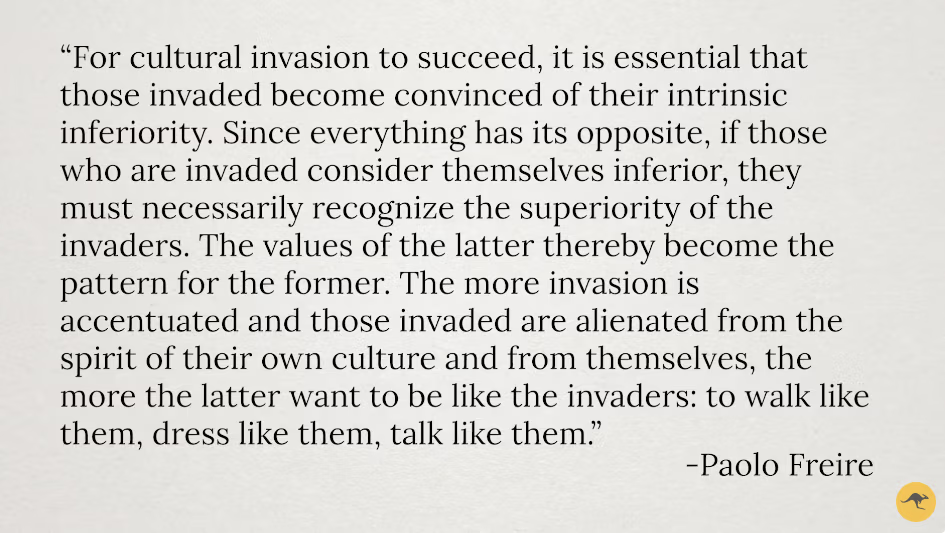
And this reveals the fundamental problem with the ideology of ‘right’ and ‘wrong’ in language: social differentiation. And when language gets associated with social class, and symbols, and culture, and that culture gets packaged, and exported, and sold around the world, it becomes cultural invasion.
Listen to the words of the great Brazilian philosopher Paolo Freire and take a moment to ask if this reflects the way that you think.
The truth is that you might find things in language that are illogical, or inappropriate, or need more context, but finding things that are really, truly, wrong in language is very difficult. But that is what the industry does when it creates materials for students. They work really, really, hard to twist language and find right/wrong questions to test you on.
It is a necessary result of the way exams work. Let’s imagine that I give you the job of testing the level of English of everyone in your country. How would you do it?
Well, you can’t test every single thing in English, because it would be impossible. So you have to select a small number of things to test that represent the whole of English.
In the world of professional testing these things are called domains and items. The domain might be English Grammar, and the item might be Phrasal Verbs. And so we select a few phrasal verbs to represent all of the phrasal verbs that you might know, and that represents your knowledge of English grammar. But now we have a really specific problem: we need to choose those phrasal verbs. Let’s try the verb ‘think’.
I need to think ____ the problem.
- about
- on
- out
- around
- through
- over
So now we have at least 6 possible answers that all work, that all have very similar but different shades of meaning, but we can’t put them on the test because we can’t test shades of meaning. We can only test yes and no. So we can only use a tiny fraction of very specific language.
How tiny? Let’s put it in perspective.

This is a standard deck of cards. 52 individual items. And every time I shuffle these cards I will get a different combination. Here’s a question: how many different possible combinations do you think there are? 1000? A million? A billion? The answer might surprise you. There are more possible combinations than atoms on Earth.
Let me explain it a different way:
Let’s imagine that there are 10 Billion people on every planet, 1 Billion planets in every solar system, 200 Billion solar systems in every galaxy, and 500 Billion galaxies in the universe. If every single person on every planet has been shuffling decks of cards completely at random at 1 Million shuffles per second since the beginning of time, you would not even come close to creating all the combinations.
And that’s with 52 things. Now let’s take a moment to think about English, which has not just 52 words, but thousands of words. The possible combinations of English are infinite. In fact almost every sentence you produce has never been said by another human being, ever, in the history of the universe. Including the sentence I just said, and the one before that.
But why is this important? It’s important because language is not a set of rules, it is a creative act. Every time you speak or write you are producing something completely new, that probably no human has ever seen or heard before, and if you only focus on right and wrong it robs you of a true understanding of language. Once you understand that language is only about acceptable and unacceptable then you are free to do the things that language is designed for: communication, expression, and creativity.
Freedom.
Freedom from worrying about whether you are good enough. Freedom from worrying about whether you have the right accent. Freedom from the fear of making mistakes. Freedom to be your true self.
I know what you’re thinking. All this talk about freedom is fine for YOU, but I live in the real world. Where I need standard English to speak correctly, and I need to pass my English exam to be successful.
The truth is that this ideology is old-fashioned and will not prepare you for the real world. The world doesn’t need or want people who can create a perfect relative clause, it needs creative people with ideas who can solve problems. And even countries that are famous for chasing ‘perfection’ are starting to see the damage that it does not just to students, but to society.

Singapore is often used as an example of the power of hard work and testing. Their education system is famous for consistently ranking number 1 in the world. But in 2016 the minister of education Ng Chee Meng admitted that they were producing the wrong kind of students:
The focus of our education system should go beyond test scores. Currently, despite our very best efforts to move towards a holistic education, there is still a narrow emphasis on academics and paper qualifications. This is deeply ingrained in our culture, translated into expectations of our children, parents, and teachers. Eventually, this is perhaps even manifested in employer mindsets in workplaces.
We need a better balance in our students’ education journey. This means dialling back an excessive focus on academics. We need to free up time and space to nurture other dimensions that are just as important for our children’s development. Let them not just study the flowers, but also stop to smell the flowers, and wonder at their beauty.
I want to finish by telling you something really important.
I don’t think your English is good.
Now you’re going to start asking yourself what makes you so imperfect, and what you did wrong for me to say that to you.
If you do not love yourself, and create protection around your heart, other people will destroy you. I won’t think your English is good, until you believe it is, and then I promise you that your English will be perfect.